Hi V.,
Here is the fixed version (without any actor) of the Activity diagram:
@startuml
skinparam style strict
skinparam activityBorderThickness 1
skinparam activityArrowColor #185E8A
skinparam activityDiamondBackgroundColor #D3D3D3
skinparam activityEndColor #FF6347
skinparam activityStartColor #7FFF00
skinparam activityBackgroundColor #F0F0F0
skinparam defaultTextAlignment center
skinparam componentStyle rectangle

title Important Agentic Steps and Sequencing

'actor User

start

:User provides **Prompt** (Get the Mission); [1]
note right
  The user initiates the AI agent's workflow by giving it a goal.
end note

partition "AI Agent Core Loop" {
  :Agent **Scans the Scene** (Gathers relevant information); [1]

  partition "Phase: Think It Through" {
    :Agent **Formulates a Plan** (Planning Pattern); [2, 3]
    note
      Decomposing complex goals into a sequence
      of smaller, actionable steps.
    end note

    split
      '--- Pathway 1: Linear Execution (Prompt Chaining) ---
      :Execute **Prompt Chain** (Step 1); [4, 5]
      -> :Execute Prompt Chain (Step 2 - uses previous output);
      -> :Final Chain Step;
    split again
      '--- Pathway 2: Conditional Logic (Routing) ---
      :Apply **Routing Logic** (Evaluate criteria); [6, 7]
      if ("Condition Met?") then (Yes)
        -> :Route to Specialized Path A;
      else (No)
        -> :Route to Specialized Path B;
      endif
    split again
      '--- Pathway 3: Concurrent Operations (Parallelization) ---
      fork
        :Perform **Parallel Task X** (e.g., Tool Use 1); [8-10]
      fork again
        :Perform **Parallel Task Y** (e.g., Tool Use 2); [8-10]
      end fork
      -> :Aggregate Parallel Results;
    split again
      '--- Pathway 4: Iterative Improvement (Reflection) ---
      :Generate Initial Output;
      :Critique Output; [11]
      repeat
        :Refine Output based on Critique; [12]
        :Re-Critique Refined Output;
      backward :Refine Output based on Critique;
      repeat while ("Not Optimal")
      -> :Optimal Output Achieved;
    end split

    :Synthesize & Finalize Internal Logic;
  }

  partition "Phase: Take Action" {
    :Agent Executes Plan\n(Involving **Tool Use** or Multi-Agent Collaboration); [1, 10, 13-15]
    note
      Utilizes external APIs, databases, or
      delegates to other agents to achieve the goal.
    end note
  }

  :Agent **Learns & Gets Better** (Adapts for future tasks); [1, 16]
  note
    Continuously improves its performance,
    strategies, and knowledge.
  end note
}

:Deliver Final Output to User;
'User <- (Final Output to User)

stop
@enduml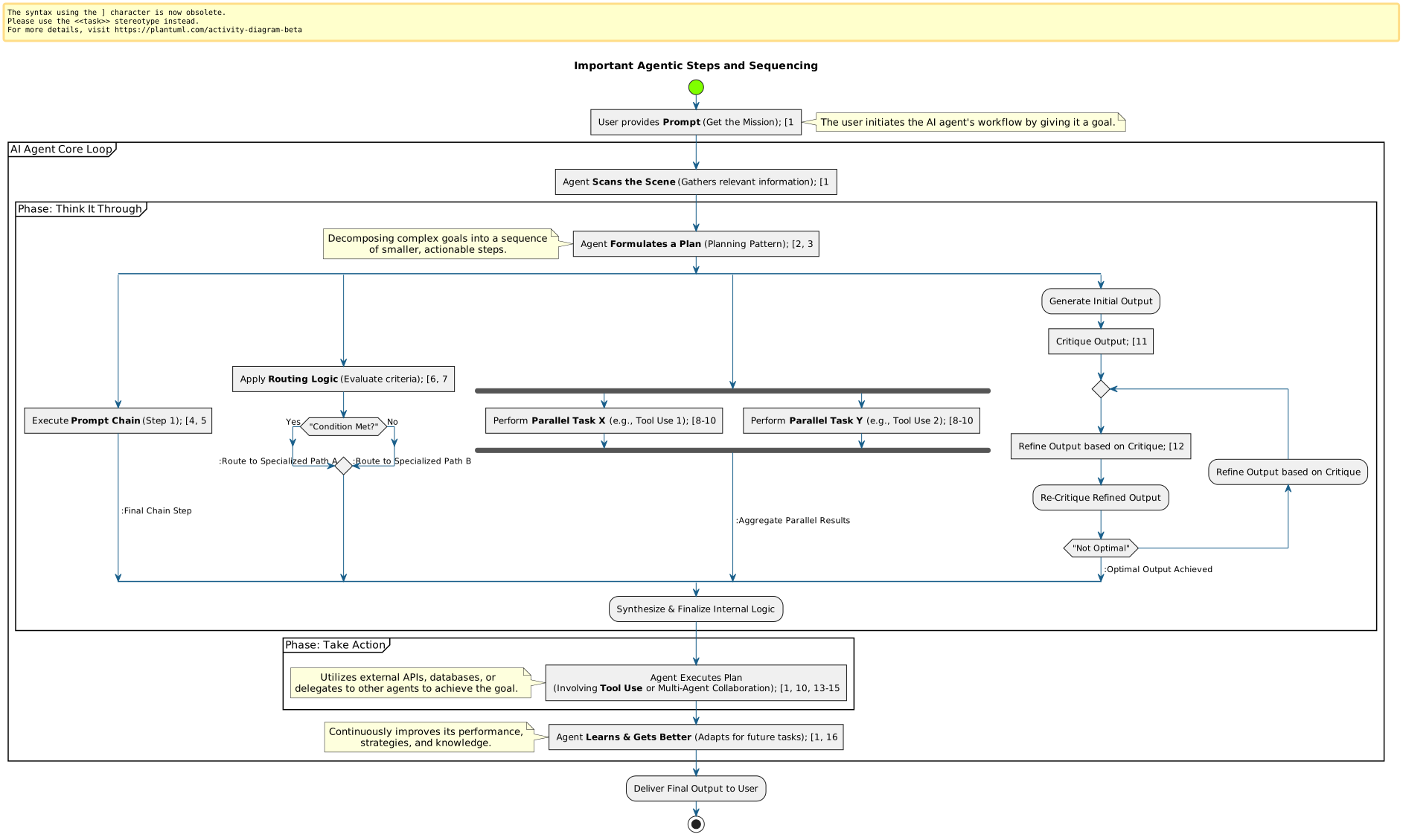
Enjoy,
Regards,
Th.