I've implemented this. A new command squeezes a stretch of the time axis:
```
break <from> to <to>
```
Example:
```
@startuml
robust "Web Browser" as WB
concise "Web User" as WU
binary "Enable" as EN
@0
WU is Idle
WB is Idle
EN is low
@100
WU is Waiting
WB is Processing
EN is high
@300 as :wait
WB is Waiting
@5000
WB is Idle
WU is Idle
EN is low
@5200
WU is Waiting
break :wait+100 to 4900
highlight 250 to 5100 #Gold : busy
WU -> WB@5000 : late
@enduml
```
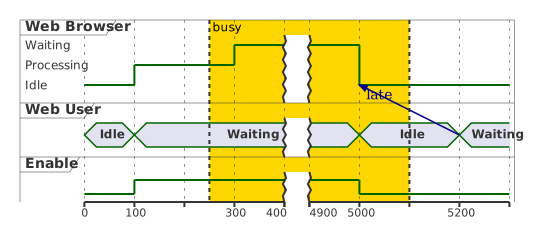
How it behaves:
- The broken stretch is squeezed to half a tick interval, so the 4,500 empty
units above take almost no space.
- On every player (binary, clock, robust, concise) the squeezed part is masked
and bordered by zigzag lines, so it reads as a tear rather than a hidden
signal. The axis line is interrupted there too.
- `<from>` and `<to>` take the same time expressions as `@`, including anchors
and offsets like `:wait+100`.
- You can use several breaks, as long as they don't overlap. A break that ends
before it starts, or overlaps another, gives an error.
- Diagrams without `break` render exactly as before.
The code and a regression test are in this pull request:
https://github.com/plantuml/plantuml/pull/2981
Feedback on the syntax or the zigzag look is welcome, especially from anyone
with a real diagram to try it on (e.g. the 24h/72h cases above).


